
Table of Contents
- What is the NYC construction superintendent One-Job Rule?
- Timeline & Key Dates
- Transition Period for Existing Jobs
- Who is Affected?
- Changes Taking Effect January 1, 2026
- Important Clarifications
- How to Become a Licensed Construction Superintendent in NYC
- Roles, Duties & Responsibilities of a Licensed Construction Superintendent
- When is a Construction Superintendent Required?
- Construction Superintendent vs. Site Safety Manager
- What Happens If Your Registration Expires?
- Common Mistakes to Avoid
- Penalties for Non-Compliance
- FAQ
- How NextWave Can Help
What is the NYC Construction Superintendent One-Job Rule?
The NYC Construction Superintendent One-Job Rule takes effect January 1, 2026, limiting primary licensed construction superintendents in New York City to one job site at a time. This is the final phase of Local Law 149 of 2021, which has gradually reduced the number of jobs a superintendent can oversee from 10 to just 1.
Why This Change Matters
The One-Job Rule aims to improve construction safety by ensuring superintendents can dedicate their full attention to a single project. Specifically, this means:
- More focused oversight of daily construction activities
- Better safety monitoring and hazard identification
- Faster response to unsafe conditions
- Greater accountability for site safety compliance
Quick Summary of What’s Changing
Before January 1, 2026:
- Primary superintendents could oversee up to 3 jobs
- “Competent persons” could substitute when the superintendent was absent
- Superintendents only needed to visit sites daily when active work occurred
After January 1, 2026:
- Primary superintendents are limited to 1 job only
- Mandatory presence during all active work hours
- Competent person substitution eliminated (alternate superintendent required instead)
Timeline & Key Dates
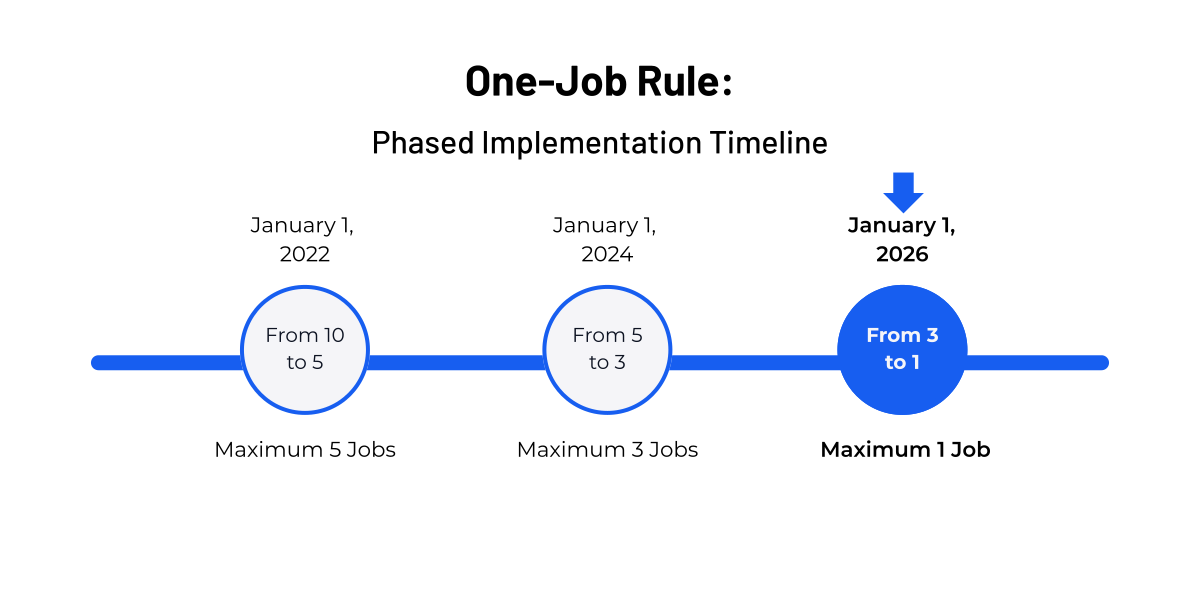
The NYC construction superintendent one-job rule has been phased in gradually:
- January 1, 2022: The Maximum was reduced from 10 jobs to 5 jobs
- January 1, 2024: The Maximum was reduced from 5 jobs to 3 jobs
- January 1, 2026: FINAL PHASE – Maximum reduced to 1 job
Important: Therefore, if you’re currently overseeing multiple jobs, you must adjust your assignments by January 1, 2026, to comply.
Transition Period for Existing Jobs
Good news for superintendents with multiple jobs: If you’re currently working on multiple non-major building jobs, you don’t have to drop them all immediately on January 1, 2026.
The DOB has created a transition period that lets you finish your existing projects while gradually moving to the one-job limit.
How the Transition Works
If you hold multiple non-major building jobs on December 31, 2025:
You can keep ALL of those jobs and continue working on them past January 1, 2026.
Here’s how it works:
Example: You’re the primary superintendent on 3 non-major building jobs on December 31, 2025.
- January 1, 2026: You can continue all 3 jobs
- Job #1 completes: You can continue with Jobs #2 and #3 (but you cannot take on a new Job #4)
- Job #2 completes: You can continue with Job #3 (but you cannot take on a new Job #4)
- Job #3 completes: Now you can take on 1 new job
Key Rule: While you’re holding multiple pre-2026 jobs, you cannot accept any new primary superintendent positions. You must complete or remove yourself from your existing jobs first.
Final Deadline: January 1, 2027
The transition period ends completely on January 1, 2027.
If you’re still holding multiple non-major building jobs from December 31, 2025, you must reduce to one job only by this date.
What This Means for You
If you currently have 2-3 jobs:
- Take a count of your active jobs as of December 31, 2025
- Plan your project timelines and completions
- Know that you have 2026 to gradually transition down to one job
If you’re looking to take on new work:
- After January 1, 2026, you can only be primary superintendent on ONE job at a time
- This applies whether it’s a major building or a non-major building job
Important: This transition period applies only to non-major building jobs you hold on December 31, 2025. It does not apply to major building jobs, and it does not allow you to take on additional jobs after January 1, 2026.
Who is Affected?
Projects That Require a Licensed Construction Superintendent
A licensed construction superintendent must be designated for:
- New building construction (any size)
- Full demolition of existing buildings
- Alterations involving:
- Vertical or horizontal enlargement
- Altering/demolishing 50%+ of gross floor area within 12 months
- Removing one or more floors within 12 months
- Work requiring special inspection for underpinning or excavation protection
- Other jobs the DOB determines pose enhanced risk
Exception: 1-3 Family Buildings
A construction superintendent is not required for work solely involving 1-3 family buildings if the permit holder is registered as a general contractor under Article 418.
Who This Rule Does NOT Affect
- Site Safety Managers/Coordinators on major buildings (different requirements)
- General contractors not serving as superintendents
- Subcontractors (unless designated as superintendent)
Changes Taking Effect January 1, 2026

The DOB’s December 18, 2025, service notice clarified important details about how the one-job rule will be implemented and provided transition periods to help superintendents adjust. Here’s what’s changing and when:
- One Job Limit Begins January 1, 2026
Starting January 1, 2026, you can only be designated as the primary construction superintendent on ONE job at a time—either a major building OR a non-major building.
This is the final phase of Local Law 149. No more juggling multiple jobs.
What You Need to Know
Effective date: January 1, 2026
The limit: ONE primary superintendent position (major or non-major building)
Exception: You can still serve as a backup or non-primary superintendent on other jobs (this doesn’t count toward your limit)
Contiguous lots: You can still be primary superintendent for multiple non-major jobs on the same lot or adjacent lots (with DOB approval)
If You Currently Have Multiple Jobs
See the “Transition Period for Existing Jobs” section above for details on how you can phase down from multiple jobs through 2026.
- Competent Person Allowance Extended Through 2026
The DOB has extended the option to designate a Competent Person through the end of 2026, giving you one more year to adjust to the new requirements.
Through December 31, 2026:
You can continue to designate a Competent Person (per Building Code Section 3301.13.12) to cover your absences.
- Both major building and non-major building jobs
- Even if you only hold one job
- Continue with daily site visits during active work (existing standard)
Starting January 1, 2027:
The Competent Person option is eliminated completely.
What this means:
- You must be physically present on site during all active work hours
- You cannot designate a Competent Person for coverage
- Only an alternate licensed construction superintendent can cover your absences
Limited exceptions where presence is not required (only if no other work is occurring):
- Surveying
- Personnel-only hoist use
- Finish troweling
- Temporary utilities installation
- Truck deliveries within a closed gate
- Painting
- Landscaping
Bottom line: Starting in 2027, if you need to be away from the site during active work, you must have another licensed construction superintendent step in—not a competent person.
- Enhanced Logging Requirements
Daily logs must include:
- Arrival/departure times (recorded immediately)
- Work progress summary
- Areas inspected
- Unsafe conditions and corrective actions
- All violations, orders, and incidents
- Personnel changes with signatures
- Weekly safety meeting records
- Weekly Safety Meetings Required
Superintendents must lead weekly safety meetings with general contractor, construction manager, and subcontractor representatives to verify compliance with building codes, site safety plans, and tenant protection plans.
Important Clarifications
The DOB service notice confirmed that certain provisions remain unchanged by the one-job rule. Here’s what you need to know:
Backup and Non-Primary Roles
The one-job limit does not affect your ability to serve as a backup or non-primary construction superintendent on additional jobs.
What this means:
- You can be the primary superintendent on 1 job
- You can simultaneously serve as a backup superintendent on other jobs
- Backup roles don’t count toward your one-job limit
- This follows Building Code Section 3301.13.6, Exception #5
Example: You’re the primary superintendent on a residential building project in Brooklyn. You can also serve as the backup superintendent on two other projects in Queens and Manhattan. The backup roles don’t violate the one-job rule.
Contiguous Lots Exception
The one-job limit does not prevent you from serving as primary superintendent for multiple non-major building jobs located on the same lot or on adjacent properties.
Requirements:
- Projects must be on the same lot or contiguous lots (properties that touch or share a boundary)
- Only applies to non-major building jobs
- Requires DOB approval*
What this means:
- Useful for developers doing phased construction on adjacent properties
- Useful for campus-style projects (schools, hospitals, housing complexes)
- You must apply to DOB and get approval—it’s not automatic
Example: A developer is renovating three townhouses side-by-side on the same block. With DOB approval, you can serve as primary superintendent for all three projects because they’re on contiguous lots.
These Exceptions Are NOT New
Both the backup role provision and the contiguous lots exception already existed before the one-job rule. The DOB service notice simply confirmed they remain in effect and are not eliminated by Local Law 149.
How to Become a Licensed Construction Superintendent in NYC

Click here to view the DOB page
Step 1: Meet Basic Qualifications
- Be at least 18 years old
- Read and write English
- Be physically fit
- Have good moral character
- Complete 40-Hour Site Safety Course (within 1 year before applying)
- Possess a valid SST Supervisor card
Step 2: Meet ONE Experience Requirement
NYC Experience: 3 years as a full-time project supervisor in NYC (within the past 5 years)
US Experience: 5 years as a full-time project supervisor in the US (within the past 8 years)
Hold Current Certificate/License:
- Site Safety Manager/Coordinator certificate
- Concrete Safety Manager registration
- Registered Design Professional (PE/RA)
- CSP or CHST from BCSP
Code Enforcement: 5 years as building code enforcement official (within the past 10 years)
Safety Professional: 5 years of field experience as a safety official/manager (within the past 10 years)
Construction Trade: 5 years of experience working with plans in the construction trade (within the past 10 years)
Note: For certain pathways, educational credit can substitute for work experience (up to 3 years).
Step 3: Complete Required Training
- Must complete within 1 year before applying
- Covers NYC Building Code, OSHA standards, safety plans, and hazard recognition
SST Supervisor Card
- Requires a minimum of 62 hours of training
- Must include: OSHA 30, 8-Hour Site Safety, 8-Hour Fall Prevention, 4-Hour Supported Scaffold, plus electives
Get SST-ready faster: NextWave’s 32-Hour Supervisor SST Bundle ($750) combined with OSHA 30 ($180) gives you exactly 62 hours—everything needed for your SST Supervisor card.
Step 4: Gather Required Documents
Upload PDF scans to the DOB NOW portal:
- LIC4 Employment History (typed, notarized)
- LIC62 Physical Exam (within 90 days)
- Experience Verification Forms (from direct supervisors, not HR)
- 40-Hour Site Safety Certificate
- Social Security History of Earnings (FICA Statement—not annual statement)
- Valid Photo ID (not expired)
- Professional Certifications (if applicable)
- Educational Transcripts (if claiming credit)
- Social Security Card
- $100 Registration Fee
Download forms from the DOB website
Step 5: Submit Application Online
- Create NYC.ID account at https://a810-dobnow.nyc.gov/Publish/Index.html#!/
- Log in to DOB NOW Portal
- Select “New License/Registration Application”
- Upload all documents
- Pay $100 fee
- Submit
Important: No walk-in applications accepted. All submissions must be online.
Step 6: Approval and Card Issuance
Once approved:
- Receive notification via DOB NOW
- Schedule a photo appointment
- Visit the DOB office
- Receive registration card
Roles, Duties & Responsibilities of a Licensed Construction Superintendent
Licensed Construction superintendents are responsible for maintaining safe, compliant job sites.
Core Superintendent Responsibilities
- Maintain Safe Job Sites
- Act responsibly to ensure site safety
- Ensure Building Code compliance
- Identify and correct unsafe conditions immediately
- Ensure Document Compliance
- Verify work follows approved construction documents, site safety plans, and tenant protection plans
- Coordinate with design professionals when applicable
- Conduct Daily Inspections
- Visit sites daily during active work (or be present full-time for One-Job Rule sites)
- Inspect all work areas and floors
- Monitor safety measures and equipment
- Correct Unsafe Conditions
- Immediately notify the responsible parties
- Order corrections or work stoppage
- Notify DOB, design professionals as required
- Document everything in daily logs
- Report to DOB Immediately
- Structural failures or equipment failures
- Serious injuries or fatalities
- Damage to adjoining property
- Any condition requiring immediate notification
- Maintain Detailed Daily Logs
- Record presence, work progress, and inspections
- Document unsafe conditions and corrective actions
- Log all violations, orders, and incidents
- Track personnel changes and safety meetings
- Lead Weekly Safety Meetings
- Meet with GC, construction manager, and subcontractors
- Verify compliance with codes and safety plans
- Document meetings in logs
- Manage Coverage (for non-One-Job sites)
- Designate competent persons when absent
- For One-Job sites after Jan 1, 2026: designate alternate licensed superintendents only
When is a Construction Superintendent Required?
Projects Requiring a Licensed Superintendent
Must designate a Licensed Construction Superintendent for:
- New building construction (any size)
- Full demolition
- Vertical or horizontal enlargement
- Alterations affecting 50%+ of floor area (12-month period)
- Floor removal (12-month period)
- Work requiring special inspection for underpinning or excavation
Exemptions
1-3 Family Buildings: No superintendent required IF the permit holder is a registered general contractor.
Major Buildings: Projects requiring site safety managers/coordinators don’t need separate superintendents (SSM/SSC fulfills this role).
When unsure: Review your permit application (DOB indicates whether it is required), consult Building Code Section 3301.13.3, or contact DOB directly.
Construction Superintendent vs. Site Safety Manager
While both roles focus on construction safety, they serve different projects with distinct requirements.

What Happens If Your Registration Expires?
Licensed Construction Superintendent Registrations must be renewed every 3 years.
Renewal (Before Expiration)
Requirements:
- Complete 8-Hour Site Safety Refresher
- Complete 4-Hour Supported Scaffold Refresher (if applicable)
- Maintain a valid SST Supervisor card
- Submit renewal application via DOB NOW
- Pay the renewal fee
- Update LIC62 Physical Exam (within 90 days)
Process: Log into DOB NOW → Select “Renew Registration” → Upload certificates → Submit
If You Let It Expire
You must start completely over:
- Retake ALL original courses (40-Hour Site Safety, all 62+ hours of SST courses)
- Submit a NEW application with all original documents
- Pay the NEW $100 application fee
- Wait for full processing (weeks to months)
- Cannot work as a licensed superintendent until reinstated
Cost Comparison
Renewal: ~$375 in refresher courses + renewal fee = days/weeks
Expired Reinstatement: ~$1,500-$2,500 in courses + $100 fee + lost work time = months
**Set reminders 6, 3, and 1 month before expiration to avoid this costly mistake.**
Common Mistakes to Avoid
Top 5 Critical Mistakes
- Wrong Social Security Document: Many applicants submit their annual Social Security Statement instead of the Social Security History of Earnings (FICA Detailed Earnings Statement). These are different documents—DOB needs the detailed earnings history. Request it directly from the Social Security Administration.
- Experience Verification from Wrong People: DOB will NOT accept letters from HR, office managers, or CFOs. You must get Experience Verification Forms from your direct field supervisors only—people who personally oversaw your on-site work. Include full dates (MM/DD/YYYY), job titles, and detailed daily duties.
- Applying Before Courses Are Complete: Don’t submit your application until you complete the 40-Hour Site Safety Course (within 1 year) and obtain your SST Supervisor card. Your application will be rejected or delayed.
- Incomplete Daily Logs: Failing to record arrival/departure times immediately, missing signatures, vague descriptions, or forgetting personnel changes can result in violations and fines. Daily logs are legal documents—treat them seriously.
- Missing Renewal Deadline: Letting your registration expire means starting completely over—retaking all courses, new application, full processing time. Set multiple reminders well in advance and complete refresher courses early.
Penalties for Non-Compliance
Failing to comply with Construction Superintendent requirements carries serious consequences:
Violations
- No licensed superintendent designated
- Superintendent not present when required
- Overseeing too many jobs (after Jan 1, 2026)
- Incomplete/falsified logs
- Failure to report unsafe conditions
- Working with expired registration
Registration Suspension/Revocation
DOB can suspend or revoke registrations for:
- Repeated violations
- Gross negligence
- Falsifying documents
- Failure to maintain qualifications
- Criminal convictions related to construction
Result: Cannot work as superintendent in NYC, must reapply, reputation damage
Stop Work Orders
DOB can halt all construction when:
- No licensed superintendent designated
- Superintendent absent when required
- Serious safety violations observed
- Required documentation missing
Impact: Project delays, financial losses, fees to lift SWO, contract penalties
Criminal & Civil Liability
In cases involving falsified documents, gross negligence, or accidents resulting from ignored hazards:
- Criminal charges possible (fines, jail time)
- Civil lawsuits from injured parties
- Personal financial liability
- Loss of professional credentials
Impact on Permit Holders & GCs
Permit holders and general contractors also face:
- Joint liability for violations
- Stop Work Orders affecting budgets and timelines
- Increased insurance costs
- Reputation damage
- Difficulty obtaining future permits
Bottom line: Non-compliance costs far more than maintaining compliance. Stay current, document thoroughly, and prioritize safety.
FAQ
When does the One-Job Rule take effect?
The NYC Construction Superintendent One-Job Rule takes effect on January 1, 2026. After this date, primary licensed construction superintendents can only be designated for one job at a time.
What happens if I already have multiple jobs on December 31, 2025?
You can continue holding those existing non-major building jobs into 2026. As each job completes, you can maintain the remaining jobs you held as of December 31, 2025, but you cannot take on additional new jobs while holding multiple jobs. By January 1, 2027, you must reduce to one job only. See the Transition Period for Existing Jobs section above for complete details.
Can I still use a Competent Person in 2026?
Yes! The DOB extended the Competent Person allowance through December 31, 2026. You can continue designating a Competent Person to cover your absences throughout 2026. Starting January 1, 2027, the Competent Person option is eliminated and you must be on-site during all active work hours (with limited exceptions), or use an alternate licensed construction superintendent for coverage.
Does the one-job limit affect my ability to be a backup superintendent?
No. You can still serve as a backup or non-primary construction superintendent on multiple jobs. The one-job limit only applies to PRIMARY superintendent designations. This means you can be primary on 1 job while serving as backup on other jobs without violating the rule.
What about projects on contiguous lots?
The one-job limit doesn’t prevent you from serving as primary superintendent for multiple non-major building jobs on the same lot or adjacent properties, subject to DOB approval. This exception is useful for phased developments or campus-style projects. You must apply to DOB for approval—it’s not automatic.
Does the One-Job Rule apply to site safety managers?
No. The One-Job Rule applies only to construction superintendents, not to site safety managers or coordinators. SSMs/SSCs are not limited to one job.
How long does it take to become a construction superintendent?
- With qualifying experience: 2-3 months (complete courses + application processing)
- Without experience: 3-5 years (depending on experience pathway)
The training itself can be completed in weeks if you’re focused.
What’s the difference between the 40-Hour Site Safety Course and the 8-Hour Site Safety Course?
- 40-Hour Site Safety: Required for initial Construction Superintendent Registration (within 1 year before applying)
- 8-Hour Site Safety (License Requirement): One of the courses for your SST Supervisor card
Both are required, but serve different purposes. You need the SST Supervisor card before applying for Construction Superintendent Registration.
Do I need an SST Supervisor card or an SST Worker card?
SST Supervisor card (62+ hours, including OSHA 30). The Worker card (40 hours with OSHA 10) is not sufficient for Construction Superintendent Registration.
What is a “Social Security History of Earnings” and how do I get it?
It’s an official document showing your year-by-year earnings—NOT your annual Social Security Statement. Request a “Non-Certified FICA Detailed Earnings Statement” from your local Social Security office (in person recommended) or at www.ssa.gov.
Do I have to be on site every single day?
Through December 31, 2026, you must make daily site visits during active work (existing standard). Starting January 1, 2027, you must be on site during all active work hours, with limited exceptions (surveying, certain hoist use, finish troweling, utilities, deliveries, painting, landscaping—only if no other work is occurring).
What happens if my registration expires?
You must start completely over: retake all 62+ hours of courses, submit a brand new application with all documents, and pay the full application fee. This is significantly more expensive and time-consuming than renewing on time.
What happens if I’m caught on multiple jobs after January 1, 2026?
If you hold multiple jobs from before December 31, 2025, you can continue them through the transition period (see above). However, if you take on multiple NEW jobs after January 1, 2026, you and the permit holders face violations, fines, Stop Work Orders, and potential suspension/revocation of your registration.
How NextWave Can Help You
At NextWave Safety, we understand the complexities of NYC construction safety requirements. Whether you’re becoming a licensed construction superintendent, maintaining your registration, or preparing for the NYC construction superintendent one-job rule, we provide the training and support you need.
View courses: https://nextwavesafety.com/courses/
Your Path to Construction Superintendent Registration
What You Need:
- 40-Hour Site Safety Course (within 1 year before applying)
- SST Supervisor Card (62 hours minimum)
The NextWave Solution:
Our 32-Hour Supervisor SST Bundle ($750), combined with OSHA 30-Hour Construction (self-paced online, $180), gives you exactly 62 hours—everything needed for your SST Supervisor card.
32-Hour Supervisor SST Bundle includes:
- 8-Hour Site Safety Refresher (Chapter 33)
- 8-Hour Fall Prevention
- 4-Hour Supported Scaffold User & Refresher
- 2-Hour Drug & Alcohol Awareness
- 2-Hour Site Safety Plan
- 2-Hour Pre-Task Meeting
- 2-Hour Toolbox Talks
- (2) 1-Hour General Electives
- (2) 1-Hour Specialized Electives
Total investment: $930 for complete SST Supervisor training
Plus, the 40-Hour Site Safety Course ($650) to complete your Licensed Construction Superintendent application.
We also offer additional training bundles for workers, renewals, and specialized needs. Please view our complete course catalog on our website.
Stay Current – Renewal & Refresher Courses
Don’t let your registration expire! We offer:
- 8-Hour Site Safety Refresher – $250
- 4-Hour Supported Scaffold Refresher – $125
- 16-Hour Supervisor SST Renewal Bundle – $400
Renewal Reminder Service: Train with NextWave, and we’ll help you track renewal dates and send reminders—so you never have to start over.
Group Training & Discounts
Training your crew? We offer special group pricing:
- Minimum 6 people
- Discounted rates on all courses
- Custom scheduling and on-site training available
Perfect for companies preparing multiple superintendents or getting teams One-Job Rule compliant.
Real Experience. Real Results.
Our instructors bring 30+ years of construction safety experience from actual job sites. You’re learning from people who’ve lived it.
Student Success Story:
“I’d like to say thank you! Every minute and every cent invested worth it. The school truly provided students with more than 30 years of experience from the instructors, all condensed into 62 hours. Every experience shared, every tip given, came from years in the field and in the classroom.”
— Tiago Santana da Costa
Why Choose NextWave?
✓ DOB-Approved Provider – Provider #CP006
✓ IACET Accredited – Nationally recognized quality
✓ Experienced Instructors – 30+ years in construction safety
✓ Flexible Scheduling – Weekly classes, online options, group training
✓ Complete Course Catalog – Initial training to renewal
✓ Competitive Pricing – Money-saving bundles and group discounts
Ready to Get Started?
Call Us: (212) 933-9071
Email: info@nextwavesafety.com
Website: www.nextwavesafety.com
Resources
- NYC Construction Superintendent One-Job Rule Quick Reference Guide
- Download the Summary of all changes
- Become a Licensed Construction Superintendent:
- Download our Registration Checklist and view course options: Here
- Renewing Your Registration?